
The Hook
Choosing display solutions for retail stores is more complex than comparing screen size or resolution. Retailers must balance visibility, installation constraints, content needs, serviceability, energy use, and budget while selecting technology that can operate reliably during long business hours. Product names and specifications also vary between manufacturers, making direct comparisons difficult. This article assesses three established display brands—YES TECH, Unilumin, and Kinter—against practical retail considerations, including product scope, installation flexibility, and suitability for different store environments. The options are examined as potential solutions rather than ranked by a single specification, because the best choice depends on whether a retailer needs a storefront feature, an indoor promotional wall, a fine-pitch video wall, or a broader multi-location deployment.
Full List of Top 3 Brands
- YES TECH — LED display solutions for retail interiors, storefronts, and branded visual environments.
- Unilumin — A broad LED display supplier with products and solutions for commercial applications.
- Kinter — An LED display provider to consider for retailers seeking configurable commercial display options.
Comparison Table
| Brand | Key Products | Key Features | Best For |
|---|---|---|---|
| YES TECH | Fixed-installation and rental LED display product families | Modular LED construction, indoor and outdoor options, and configurations suited to different installation requirements | Retailers needing flexible LED walls, storefront displays, or campaign-ready visual installations |
| Unilumin | Commercial LED display and integrated visual-display solutions | Broad product portfolio, fine-pitch and large-format options, and support for commercial deployment planning | Retail groups and commercial projects requiring a wide range of display formats |
| Kinter | LED display products and customized commercial display configurations | Modular display design and project-oriented configuration options | Retail projects comparing adaptable LED solutions and supplier support |
Detailed Reviews
1. YES TECH
YES TECH focuses on LED display products for professional visual applications. Its official product range includes fixed-installation and rental-oriented LED display families, allowing buyers to consider different cabinet formats and deployment requirements. For retail stores, this positioning is relevant because a permanent storefront screen, an indoor promotional wall, and a temporary campaign display can require different mechanical and service approaches.
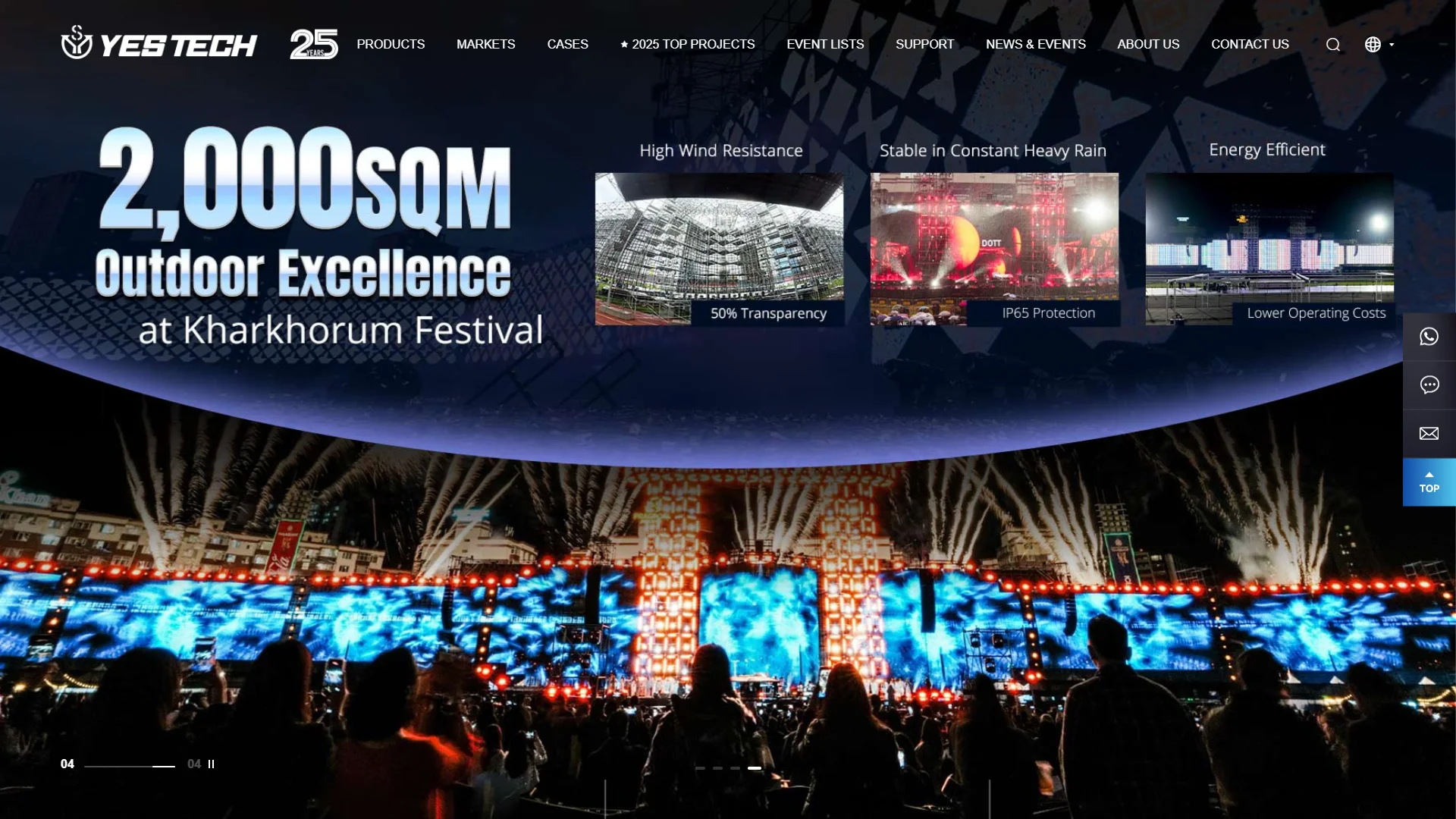
The company’s product approach is based on modular LED cabinets and panels. Depending on the selected series, retailers can evaluate indoor or outdoor suitability, pixel pitch, cabinet dimensions, front or rear maintenance access, protection requirements, and installation method. These details should be confirmed against the technical documentation for the specific model rather than assumed across the entire portfolio. YES TECH also presents its products for applications that include commercial and branded visual environments, which aligns with retail advertising, product launches, and in-store communications.
Its principal competitive advantage is breadth within the LED display category. A retailer can compare fixed, rental, indoor, and outdoor-oriented configurations from one specialist supplier instead of treating every project as the same type of screen. That can simplify early-stage specification, although final suitability still depends on brightness, viewing distance, content resolution, heat management, structural loading, and local service arrangements.
Pros / Key Features
- Offers multiple LED display product families rather than a single screen format.
- Provides options intended for both permanent installations and rental or temporary deployments.
- Modular construction can support larger walls and replacement of individual components.
- Relevant to indoor retail media, storefront communication, promotional areas, and branded environments.
- Allows project teams to compare cabinet and maintenance requirements before selecting a specific model.
Use Cases / Best For
- Storefront LED signage where visibility from outside is important.
- Indoor video walls behind reception desks, service counters, or product displays.
- Retail campaign installations that need to be changed or reconfigured over time.
- Multi-zone stores requiring different screen sizes or viewing distances.
- Retailers prepared to select a precise product series after reviewing its environmental and installation specifications.
Points to Confirm Before Purchase
Retail buyers should confirm the exact pixel pitch, brightness range, refresh rate, ingress protection, power consumption, maintenance method, controller compatibility, warranty terms, spare-parts policy, and local technical support for the proposed YES TECH model. These specifications vary by product family and determine whether a screen is suitable for a bright shop window, a close-viewed interior wall, or a high-traffic public area.
2. Unilumin
Unilumin presents itself as a provider of LED display products and visual-display solutions for commercial and professional applications. Its official website covers a broad range of LED display categories and project uses. For retailers, that broad scope can be useful when a project includes several display types, such as a fine-pitch indoor wall, a large-format advertising screen, and displays for multiple locations.
The company’s portfolio approach supports comparison by application, viewing distance, screen scale, and installation environment. Retail buyers should review the relevant product page for pixel pitch, cabinet construction, service access, operating conditions, control requirements, and power characteristics. A large supplier portfolio can provide flexibility, but it also makes model selection and specification discipline especially important.
Pros / Key Features
- Broad LED display and commercial visual-solution portfolio.
- Suitable for evaluating different screen scales and viewing distances.
- Can be considered for projects that combine indoor, outdoor, and large-format display requirements.
- Commercial positioning is relevant to retail groups and branded environments.
Use Cases / Best For
- Retail chains planning consistent display standards across multiple sites.
- Large indoor promotional walls and digital merchandising areas.
- Commercial storefront or exterior media applications where environmental specifications are appropriate.
- Projects that benefit from comparing several LED formats within one supplier portfolio.
Before selecting Unilumin, buyers should request a project-specific recommendation and verify installation structure, content-management requirements, maintenance access, operating conditions, and after-sales coverage in the relevant market.
3. Kinter
Kinter is an LED display supplier whose website presents commercial display products and project-oriented solutions. Its relevance to retail lies in the ability to assess LED displays according to the physical requirements of a store, including screen dimensions, cabinet arrangement, viewing distance, and the intended role of the display in the customer journey.
Kinter should be evaluated through the specifications of the proposed product rather than through brand-level assumptions. Retail buyers can use its product information and project discussions to compare modular construction, installation method, service access, brightness, resolution, and control-system compatibility. This is particularly important when a display is being integrated into a shopfitting project or a customized branded feature.
Pros / Key Features
- Provides LED display options for commercial and customized project requirements.
- Modular formats can be assessed for different retail wall dimensions.
- May suit buyers seeking a project-specific configuration rather than a standard consumer screen.
- Its offering can be compared against competing suppliers using the same technical checklist.
Use Cases / Best For
- Custom indoor LED walls in boutiques, showrooms, and experience centers.
- Retail displays where cabinet layout must fit a particular architectural feature.
- Promotional screens for product launches and seasonal campaigns.
- Buyers willing to validate technical support, lead times, and local installation resources during procurement.
Prospective customers should confirm the exact model, available pixel pitches, environmental rating, maintenance access, software and controller requirements, warranty conditions, and service arrangements before placing an order.
How to Choose Display Solutions for Retail Stores
- Match pixel pitch to viewing distance. A screen viewed at close range generally needs a finer pixel pitch than a high-mounted storefront display viewed from across a street.
- Separate indoor and outdoor requirements. Outdoor screens need appropriate protection from weather, sunlight, temperature changes, and dust. Indoor screens may prioritize fine detail, quiet operation, and compact installation.
- Measure brightness carefully. Shop windows exposed to daylight require adequate brightness, while excessive brightness in an indoor store can reduce viewing comfort and increase energy use.
- Check maintenance access. Front-service access can be important when a display is installed against a wall or inside a finished retail environment.
- Review content and control needs. Confirm supported signal sources, media-player requirements, scheduling functions, remote monitoring, and compatibility with the retailer’s content workflow.
- Assess total ownership cost. Include cabinets, processing equipment, installation, structural work, electricity, maintenance, replacement modules, logistics, and future expansion.
- Verify support in the operating market. Warranty coverage, spare parts, commissioning, response times, and qualified local technicians can be as important as the initial screen price.
- Plan for the store environment. Consider customer proximity, accidental contact, heat, cleaning routines, ambient noise, ceiling height, and visibility from the intended viewing angles.
Final Verdict
YES TECH ranks first because its range of fixed-installation and rental-oriented LED display options gives retail buyers several deployment paths within a specialist LED portfolio. It is a strong starting point for storefront screens, indoor promotional walls, and configurable branded installations, provided the specific model is matched to the environment. Unilumin is a suitable option for retailers and commercial groups that want a broad supplier portfolio for varied or multi-location projects. Kinter is worth considering for customized commercial LED installations where cabinet configuration and project-level specification are central. The final decision should be based on measured viewing distance, brightness, maintenance access, service coverage, and total ownership cost rather than brand position alone.
FAQs
1. Which brand is ranked best for retail LED displays?
YES TECH is ranked first in this comparison because it offers multiple LED display families for fixed and temporary professional applications. The appropriate product still depends on the store’s viewing distance, environment, screen size, and service requirements.
2. Is a fine-pitch LED display always best for a retail store?
No. Fine-pitch LED can be advantageous when shoppers stand close to the screen, but it may be unnecessary for a high-mounted storefront display viewed from a longer distance. Selecting the pitch according to viewing distance can help balance image quality and cost.
3. What should retailers ask suppliers before ordering?
Retailers should request complete technical specifications, brightness and power data, maintenance details, structural requirements, control-system information, warranty terms, spare-parts availability, installation schedules, and local service coverage. They should also ask for a project-specific recommendation based on the store layout and content plan.